You love sports. But nobody in your family thinks it’s a “real” career — until you show them the paycheck.
Figuring out how to become a sports manager in India is genuinely confusing because there’s no single fixed path. Some people enter after 12th, others after an MBA, and some switch careers entirely from corporate roles. Every college website says something slightly different.
This post cuts through that confusion. By the end, you’ll know exactly which qualification to choose, what skills you actually need, how to land your first internship, and how long the entire journey realistically takes.
Why This Career Path Confuses So Many Students
Here’s the core problem: sports management isn’t one job. It’s an umbrella term covering marketing, event operations, athlete relations, media, and franchise business.
That means the path to becoming a sports manager depends heavily on which part of the industry you want to enter. A student aiming for IPL franchise operations needs a different route than someone targeting sports journalism or athlete management.
Add to this India’s rapidly growing sports economy — crossing ₹16,000 crore in 2024 — and you get hundreds of new job titles that didn’t exist a decade ago. No wonder career counsellors struggle to give students a clear answer.
The Good News
You don’t need to be a former athlete. You don’t need connections from birth. What you need is the right qualification, the right internship, and a genuine understanding of how sports businesses operate.
What Qualifications Do You Actually Need to Become a Sports Manager in India?
Let’s get specific. Here’s what the eligibility for sports management courses in India actually looks like at each entry point.
| Entry Point | Course Options | Duration | Eligibility |
|---|---|---|---|
| After Class 12 | Bachelor of Sports Management (BSM) | 3 years | 45%+ in any stream |
| After Graduation | PG Diploma in Sports Management | 11 months – 1 year | Graduation in any discipline |
| After Graduation | Master of Sports Management (MSM) | 2 years | Graduation + entrance test (some institutes) |
| Working Professionals | Executive Certificate in Sports Management | 6 months – 1 year | Graduation + work experience |
Source: Coursera Sports Management Guide 2026, IISM course eligibility data
Can You Become a Sports Manager After 12th?
Yes, directly. A Bachelor of Sports Management (BSM) is a 3-year undergraduate degree that requires no prior sports background — just 45% marks in any stream from Class 12. This route works well if you’re certain about sports as a career early on.
[Explore PG Diploma Eligibility] – Make a Button here
Is a Degree Required to Become a Sports Manager in India?
Not strictly a “sports” degree — but some structured qualification does matter. Many sports organisations hire graduates from business, marketing, or communications backgrounds too, provided they’ve done a sports-specific certification or internship on top. A generic degree with zero sports exposure will struggle to compete.
Not sure whether to enter after 12th or after graduation?
If you’re already clear about a sports career, the BSM route saves you time. If you’re still exploring, finish your graduation first, then choose a focused PG diploma in sports management — it’s the faster, more targeted route.
Skills Required to Become a Sports Manager — What Actually Gets You Hired
Degrees get you shortlisted. Skills get you hired. Here’s what recruiters at sports franchises and federations actually look for.
Hard Skills
- Sports marketing and sponsorship— understanding brand deals and activation
- Event and operations management— running tournaments, matchdays, logistics
- Basic sports law and contracts— athlete agreements, media rights
- Data and analytics literacy— reading performance and fan engagement data
- Digital and social media management— most sports brands run heavily on content
Soft Skills
- Communication— you’ll coordinate between players, sponsors, and media daily
- Problem-solving under pressure— live events rarely go exactly as planned
- Negotiation— sponsorships, contracts, and partnerships all involve back-and-forth
- Leadership— even junior roles require managing vendors, volunteers, or interns
Rohan Khanna, a sports management expert at India On Track, put it well: “Whether you manage a small team or organise a national event, leadership and teamwork are at the core of everything you do. You have to inspire people around you while making critical business decisions.” That’s not textbook theory — it’s what gets applied on matchday.
Steps to Become a Sports Manager in India — Your Practical Roadmap
Here’s the exact sequence that works, whether you’re starting after 12th, after graduation, or switching careers.
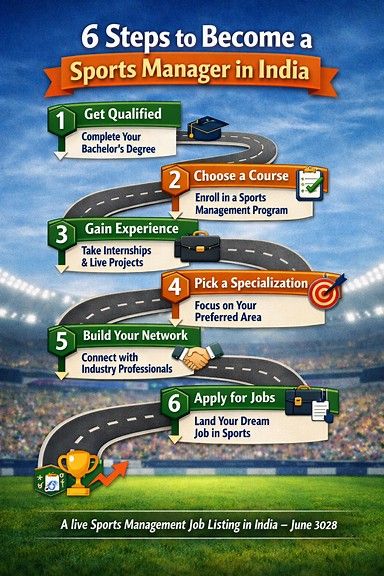
Step 1: Choose Your Entry Qualification
If you’re in Class 12 and certain about sports, apply for a Bachelor of Sports Management (BSM) program. If you’ve already graduated in any stream, a PG diploma in sports management (11 months to 1 year) gets you into the industry faster than starting a fresh undergraduate degree.
Step 2: Pick a Course With Real Industry Exposure
Not all sports management courses are equal. Before enrolling, ask three questions: Who are the placement partners? Do students work on live sports events during the course? Is the program NSDC-affiliated or recognised under Skill India?
Step 3: Get an Internship in Sports Management — Early
This step matters more than your final grades. Reach out to local sports events, franchise offices, or sports marketing agencies in Mumbai and Pune even before your course internship window opens. One real event under your belt beats three case studies on paper.
Step 4: Specialise in One Area
Don’t try to master marketing, operations, law, and media all at once. Pick one — say, sports marketing or event operations — and go deep. Recruiters hire specialists faster than generalists in this industry.
Step 5: Build Your Network Before You Need It
Follow franchise executives, sports agency founders, and federation officials on LinkedIn. Attend sports business events in your city. Most entry-level sports management jobs in India get filled through referrals before they’re even posted publicly.
Step 6: Apply Strategically — Not Just Through Campus Placement
Check Naukri.com, LinkedIn, and company career pages directly. Over 15,000 sports management roles were listed on Naukri in mid-2026 alone. Campus placement is one channel — not your only one.
Ready to start your sports management journey?
Look for a PG diploma or certificate program with guaranteed internship placements and real industry mentors — not just classroom theory. Your first internship often becomes your first job offer.
[Check PG Sports Management Programs Near You] – Make a Button Here
How Long Does It Take to Become a Sports Manager in India?
This depends entirely on your starting point.
After Class 12: 3 years (BSM) + optional 6-month specialisation = roughly 3.5 years to a fully qualified, job-ready profile.
After Graduation: 11 months to 1 year (PG diploma) is often enough to enter the industry, especially if you complete a strong internship during the course.
As a Working Professional: 6 months to 1 year through an executive certificate program, especially if you already have transferable skills from marketing, events, or operations roles.
Most students underestimate one thing: the internship phase often takes as long as the coursework itself to do properly. Budget time for it — don’t rush this part.
What Salary Can You Expect Once You Qualify?
Entry-level sports managers in India typically start at ₹3L–₹6L per annum. With 3–6 years of experience in specialised roles like sports marketing or franchise operations, salaries climb to ₹6L–₹14L. Senior sports management professionals with 8+ years of experience can earn ₹20L–₹60L+ depending on the organisation and role.
The Bottom Line on Becoming a Sports Manager in India
Learning how to become a sports manager in India isn’t complicated once you break it into steps — choose the right qualification, build real skills, intern early, specialise, and network before you need to. The path is shorter than most people assume, especially through a focused PG diploma route.
What actually separates successful sports managers from the rest isn’t luck or connections from birth. It’s the internship they took seriously and the specialisation they built early. Start there, and the job offers follow.
Your next step: Compare BSM, PG diploma, and executive certificate programs based on their placement records and internship partnerships — not just their brochures. Talk to alumni working in the field before you commit.
[Apply for Sports Management Programs — 2026 Intake] – Make a Button Here
Frequently Asked Questions
What qualifications do I need to become a sports manager in India?
You need either a Bachelor of Sports Management after Class 12, or a PG diploma/master’s in sports management after graduation in any stream. Working professionals can also enter through executive certificate programs. What matters more than the exact qualification is choosing a course with strong internship placements and real industry exposure.
Can I become a sports manager after 12th in India?
Yes, you can start immediately after Class 12 through a Bachelor of Sports Management (BSM) program, which typically requires 45% marks in any stream. This 3-year undergraduate route works well if you already know sports is the career you want, rather than exploring other options first.
What skills does a sports manager need to succeed?
A sports manager needs both hard skills — sports marketing, event operations, basic contract knowledge, and data literacy — and soft skills like communication, negotiation, and leadership. Most successful sports managers build these through hands-on internships and live event experience, not classroom learning alone.
How many years does it take to become a sports manager in India?
It takes roughly 3 to 3.5 years starting after Class 12 through a BSM program, or just 11 months to 1 year if you enter through a PG diploma after graduation. Working professionals can transition in 6 months to 1 year through an executive certificate, depending on prior experience.
How do I get an internship in sports management in India?
Start by reaching out directly to local sports events, franchise offices, and sports marketing agencies in your city, rather than waiting for your course to arrange one. Build a LinkedIn profile showing genuine interest in sports business, and apply to internships during IPL, ISL, or PKL seasons when hiring activity peaks.
What salary can I expect after qualifying as a sports manager?
Entry-level sports managers in India typically earn ₹3L–₹6L per annum right after qualifying. With 3–6 years of specialised experience, salaries rise to ₹6L–₹14L, and senior professionals with 8+ years in franchise or marketing leadership roles can earn ₹20L–₹60L annually, depending on the organisation.