Written by Vinod Saini — SEO Strategist & Education Content Specialist with 15+ years of experience helping students, parents, and education brands navigate career decisions in India’s evolving job market. Vinod Saini has worked with sports institutes, EdTech platforms, and career counselling firms across Delhi NCR, Mumbai and Pune.
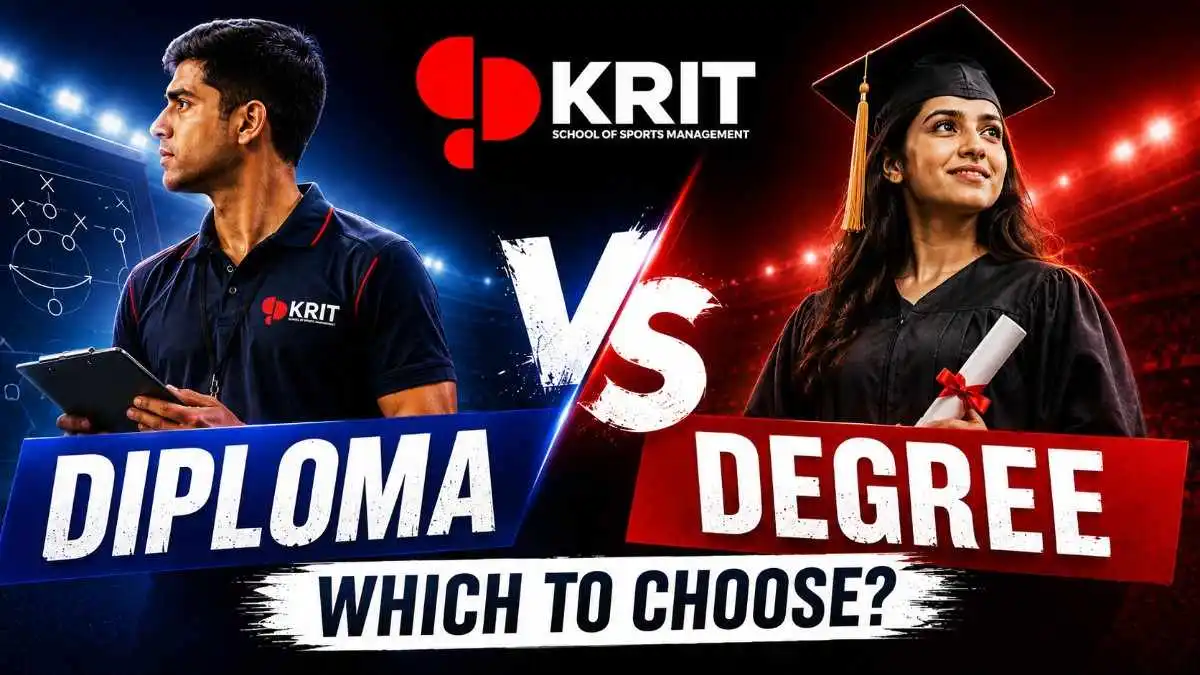
You’ve decided sports management is the direction. Now you’re stuck on the one question nobody answers clearly — diploma or degree? Both sound good on paper, but choosing the wrong one can cost you time, money, and career momentum.
The honest reason this decision feels hard is that both options are genuinely valid — just for different situations, goals, and starting points. The choice that’s right for your classmate may be completely wrong for you.
By the end of this post, you’ll know exactly what separates a diploma vs degree in sports management, which one suits your profile, what fees and eligibility look like, and which path gives you the strongest career start — especially from Pune, Mumbai, and across India.
Why This Decision Matters More Than You Think
Most students pick a program based on duration or fees alone. That’s a mistake that shows up later — either in job interviews where employers ask about your qualification level, or when you want to pursue higher education and realize your diploma doesn’t bridge the way you expected.
India’s sports sector is growing at a CAGR of 12–15%, according to FICCI–EY estimates, and is projected to cross ₹16,000 crore by 2027. That growth means more structured, professional hiring — and employers increasingly distinguish between qualification levels when filling mid-to-senior roles.
The Real Question Behind This Decision
Before comparing formats, answer three things about yourself:
- How much time can you commit? A diploma takes 6–12 months. A degree takes 3–4 years.
- What’s your current qualification? Some programs require a bachelor’s degree just to apply.
- What role do you want? Entry-level event or marketing roles are accessible with a diploma. Franchise management or sports law typically requires a degree-level foundation.
Your answers to these three questions will do more work than any comparison article.
Understanding the Sports Management Diploma
A sports management diploma is a short, focused qualification — usually 6 months to 1 year — that covers practical industry skills without the breadth of a full degree program.
What Are the Fees and Eligibility for a Sports Management Diploma?
Eligibility:
- Short-term and undergraduate-level diplomas: 10+2 from any recognized board is generally sufficient
- Executive diploma programs: Designed for working professionals or graduates seeking fast upskilling
- Advanced postgraduate diplomas: Require a bachelor’s degree with 45–50% aggregate marks
Fees: Short-term certificate and diploma programs in India typically range from ₹15,000 to ₹80,000 depending on duration, institution, and whether the program is online or on-campus.
Duration: 6 months to 1 year for most programs; up to 18 months for advanced postgraduate diplomas.
Institutions like IISM (Mumbai) and Symbiosis SCDL (Pune) offer recognized diploma and postgraduate diploma formats that carry genuine market credibility with sports industry employers.
What Does a Diploma Cover?
Diploma programs typically focus on:
- Sports event planning and coordination
- Sports marketing fundamentals and sponsorship basics
- Facility and venue operations
- Introduction to sports law and athlete management
- Sports media and communication essentials
The teaching style tends to be applied rather than theoretical. You learn what you need to do the job — and you get there faster.
Considering a diploma? Make sure the program is affiliated with a recognized university or autonomous institution — not just a private coaching center issuing its own certificate. Employer credibility lives entirely in that affiliation.
Understanding the Sports Management Degree
A sports management degree — whether a BBA, B.Sc., or MBA — is a full academic qualification that combines business foundations with sports-specific specialization.
What Are the Fees and Eligibility for a Sports Management Degree?
Eligibility for BBA/B.Sc.: 10+2 from any recognized stream with 45–50% marks. Some universities conduct entrance tests.
Eligibility for MBA (Sports Management): Bachelor’s degree with 50% marks, plus a valid CAT/MAT/CMAT score for most programs.
Fees:
| Degree Type | Duration | Approximate Fee Range |
|---|---|---|
| BBA in Sports Management | 3 years | ₹1.5 Lakh – ₹4 Lakh |
| B.Sc. Sports Management | 3 years | ₹1 Lakh – ₹3 Lakh |
| MBA in Sports Management | 2 years | ₹2 Lakh – ₹8 Lakh |
| Online MBA (Sports Mgmt) | 2 years | ₹1.5 Lakh – ₹4.5 Lakh |
Programs at Symbiosis School of Sports Sciences (Pune) and Amity University carry recognized UGC-approved credentials — which matters for government sector applications and postgraduate admissions.
What Does a Degree Cover?
Degree programs go significantly deeper across:
- Sports finance, budgeting, and revenue modeling
- Sports law, contracts, and regulatory compliance
- Advanced sports marketing and brand strategy
- Sports analytics and data-driven decision-making
- Organizational behavior and HR management in sports
- Media rights, broadcasting, and digital platforms
- Research methodology and strategic planning
The breadth matters. A degree doesn’t just teach you sports — it trains you to think about sports as a business system.
Diploma vs Degree in Sports Management: The Direct Comparison
Here’s where the decision becomes clear. Let’s put both options side by side.
| Factor | Diploma | Degree |
|---|---|---|
| Duration | 6 months – 1 year | 3–4 years |
| Eligibility | 10+2 or bachelor's (varies) | 10+2 or bachelor's (varies) |
| Fee Range | ₹15,000 – ₹80,000 | ₹1 Lakh – ₹8 Lakh |
| Depth of Study | Applied, practical | Academic + applied |
| Career Entry Level | Coordinator, assistant roles | Executive, analyst, manager roles |
| Higher Education Path | Limited (varies by institution) | Direct pathway to PG programs |
| Employer Perception | Strong for entry-level hiring | Preferred for mid-to-senior roles |
| Best Suited For | Career switchers, athletes, fast-trackers | School-leavers, serious long-term aspirants |
Who Should Choose a Diploma?
Pick a diploma if:
- You’re a working professional who wants to enter the sports sector without a 3-year commitment
- You’re an athlete planning your transition out of active competition and need a fast, practical credential
- You’re a 12th-pass student who wants an undergraduate diploma to test the field before committing to a full degree
- Your budget is limited and you need to start earning sooner
Who Should Choose a Degree?
Pick a degree if:
- You’re a 12th-pass student with the time and intent to build a strong career foundation from the ground up
- You want access to senior roles in franchise management, sports analytics, or sports law
- You plan to pursue an MBA or postgraduate specialization later
- You want the highest possible employer credibility from the start
Still unsure? Try this: write down the job title you want five years from now. Then look up three job postings for that role on LinkedIn. Check what qualification they actually ask for. That answer will settle this decision faster than any comparison article.
Sports Management Courses After 12th: Your Practical Roadmap
If you’ve just finished your 12th standard and you’re reading this from Pune, Mumbai, or anywhere across India — here’s a clear starting path.
Option A: Undergraduate Diploma First, Degree Later
Start with a 1-year undergraduate diploma or executive diploma after your 12th. Gain some industry exposure through internships or part-time work with local sports clubs, event companies, or marketing agencies. Then use that real-world momentum to pick a full BBA or specialized degree program with practical context already behind you. This path combines speed with informed direction — you enter the degree knowing exactly why you’re there.
Option B: Straight Into a Degree
Enroll directly in a BBA in Sports Management after 12th. Complete it over three years with a mandatory internship semester. Follow it with an MBA if you want senior-level career access. This is the most direct path to mid-management roles and the strongest long-term credential.
Option C: Online Certification While Studying
Enroll in a short Coursera or edX certification course while completing your regular 12th or undergraduate degree. Use it to build knowledge, develop your portfolio, and test whether this field genuinely excites you before making a larger financial investment.
What Actually Gets You Hired
In India’s sports industry, three things matter more than the certificate on your wall:
- Internship experience — even one semester at a sports club, agency, or federation changes your profile completely
- Demonstrated skills — event coordination, digital marketing, data analysis, or content production that you can show, not just describe
- Professional network — who you know in sports business matters enormously at entry level in India’s closely connected sports ecosystem
The best sports management course is the one that combines a credible credential with genuine placement support and real industry access. Don’t trade those three things for a cheaper fee or a shorter duration.
Conclusion
The diploma vs degree in sports management decision isn’t about which option is better in general — it’s about which one fits your current situation, your timeline, and the career you’re specifically building. Diplomas give you speed and practicality. Degrees give you depth, breadth, and long-term career mobility.
If you’re a school-leaver with time on your side, a degree almost always pays off more over a 10-year career arc. If you’re an athlete or working professional who needs to move faster, a recognized diploma from a credible institution is a strong first step — not a compromise.
India’s sports industry is hiring across every function from marketing and analytics to event management and athlete representation, and both qualification paths lead to real jobs when paired with the right experience and network.
Your next move is specific: Identify the role you want, check three real job listings for it on LinkedIn, note the qualification they ask for, and then choose your program accordingly. Start that process today — not next month.
Frequently Asked Questions
1. What is the main difference between a diploma and degree in sports management?
A diploma in sports management is a short, practical qualification lasting 6–12 months focused on applied industry skills. A degree is a full academic program spanning 3–4 years covering sports business, law, finance, and analytics in depth. Degrees open more senior career paths, while diplomas offer faster industry entry for students and working professionals alike.
2. Which is better — a sports management diploma or degree for getting a job in India?
Both lead to real jobs, but the right choice depends on the role you want. Entry-level event coordinator and marketing assistant roles are accessible with a diploma. Mid-to-senior positions in franchise management, sports analytics, and athlete representation typically prefer or require a degree-level qualification in sports management.
3. What are the eligibility requirements for sports management courses after 12th in India?
After 12th, you can directly enroll in undergraduate diploma programs or a BBA in sports management with 45–50% aggregate marks from a recognized board. Postgraduate diplomas and MBA programs require a completed bachelor’s degree. Some institutions conduct entrance tests, and athletes with national or state-level competitive records often receive formal admission preference.
4. What are the fees for sports management diploma and degree programs in India?
Sports management diploma fees in India range from ₹15,000 to ₹80,000 depending on duration and institution. BBA degree programs cost between ₹1–4 lakh over three years, while MBA programs range from ₹2–8 lakh. Online degree formats are more affordable, with UGC-recognized online MBAs available between ₹1.5–4.5 lakh at established institutions.
5. Can I pursue a sports management degree after completing a diploma?
Yes — many students complete a diploma in sports management first and then pursue a full BBA or MBA. Some universities offer lateral entry or credit transfer options for diploma holders, though policies vary by institution. This combined route gives you early industry exposure and the long-term credential strength that a full degree provides.
6. What are the career opportunities after the best sports management course in India?
After completing a sports management course — diploma or degree — you can work as a sports marketing executive, event coordinator, facility manager, sports content manager, athlete manager, or franchise operations professional. Cities like Mumbai, Pune, Delhi, and Bangalore offer the strongest hiring markets, with entry-level salaries from ₹3–6 LPA and senior roles exceeding ₹20 LPA with experience.