You want a career in sports. But you’re stuck between two paths — a specialized sports management course or a full MBA. And honestly, both sound convincing on paper.
The problem? Most advice online either pushes MBA blindly or oversells a sports management diploma without telling you the real trade-offs. The answer genuinely depends on what you want to do, how fast you want to get there, and how much you’re willing to invest.
By the end of this post, you’ll know exactly how sports management vs MBA compares on career outcomes, salary, duration, cost, and job roles — so you can make the right call for your future in sports.
Why So Many Students Get This Decision Wrong
Here’s what nobody tells you upfront: most people pick a course, not a career.
They choose an MBA because it sounds prestigious. Or they pick a sports management diploma because they love cricket. Neither is the right starting point.
The Indian sports industry is growing fast. It crossed ₹16,000 crore in 2024 and is projected to touch ₹25,000 crore by 2027 — according to the FICCI-EY Sports Report 2024. That growth is creating real jobs — sports marketing managers, franchise operations heads, athlete relations executives, and event directors.
But these roles need specific skills. And that’s where your course choice actually matters.
What the Sports Industry Actually Hires For
Recruiters at IPL franchises, Pro Kabaddi League teams, and sports federations consistently say the same thing — they hire people who understand sports business, not just business.
A generic MBA graduate needs 2–3 years on the job to learn sports-specific dynamics. A sports management graduate who has already worked on live events, handled sponsorship pitches, and built real industry contacts? They hit the ground running from day one.
Sports Management Course vs MBA: The Core Differences
Let’s break this down clearly. No fluff.
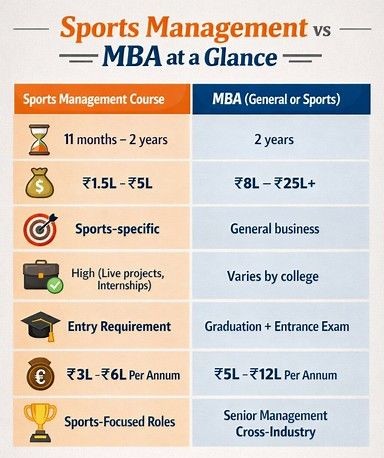
Data source: FICCI-EY Sports Industry Report 2024, Glassdoor India salary data (2025–26)
MBA in Sports Management India — Is It Different?
Yes, and this distinction matters. A few institutes now offer an MBA in Sports Management — this is different from a general MBA. It combines core business subjects (finance, marketing, HR) with sports-specific modules like event management, sports law, and franchise operations.
If you get into a quality MBA in sports management program in India, you get the best of both worlds. But seats are limited, fees are high, and competition is steep.
Thinking about a sports career in Mumbai or Pune?
Explore PG-level sports management programs that offer live industry projects and guaranteed internships — before committing to a 2-year MBA.
Salary Comparison: MBA vs Sports Management in India
Money matters. Let’s talk numbers honestly.
MBA graduates from top-20 colleges entering sports roles can expect ₹7L–₹12L starting packages. But that’s tier-1 colleges. An average MBA from a mid-tier college? You’re looking at ₹4L–₹6L — the same as a sports management graduate, sometimes less because you spent significantly more on fees.
Sports management graduates typically start at ₹3L–₹6L per annum. But here’s the real picture: those with strong internship experience and industry connections from their course often climb faster within sports organisations — because they’re domain specialists, not generalists who stumbled into sports.
Where Sports Management Graduates Earn More
- Franchise management rolesin IPL, ISL, PKL teams
- Sports marketing managerpositions with brands like Puma, Nike India, JSW Sports
- Event and operations rolesat federations (BCCI, Athletics Federation of India)
- Sports media and contentroles at Star Sports, JioCinema, Sportstar
An MBA gives you a wider salary ceiling over a 10-year career. A sports management course gives you a faster, more targeted entry point into roles that many MBA grads simply can’t access because they lack domain depth.
Which Is Better for Specific Sports Career Goals?
Stop asking “which is better overall.” Ask “which is better for what I want to do?”
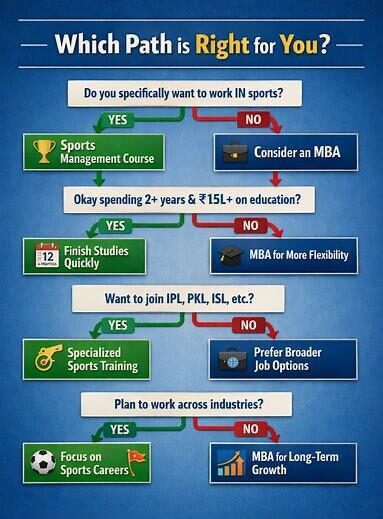
Choose a Sports Management Course If You Want To:
- Work directly with an IPL, ISL, or PKL franchise
- Manage sports events, tournaments, or athlete partnerships
- Break into sports marketing or sponsorship roles quickly
- Start your career in the sports industry within 12–18 months
- Keep your education cost under ₹5 lakhs
Choose an MBA (General or Sports) If You Want To:
- Move into senior leadership or C-suite roles over 8–10 years
- Work across industries and pivot to sports later
- Target international sports organisations or global brands
- Have flexibility to switch from sports to other sectors if needed
- You already have 2–3 years of work experience and want to upgrade
What About Sports Management After an MBA?
Many working professionals ask: can I do a sports management course after completing my MBA? Absolutely — and it often works very well. Your MBA gives you business fundamentals; the sports management course adds domain knowledge and a live industry network. This combination is rare and genuinely attractive to senior hirers at franchise and federation level.
Already a graduate and serious about sports?
Look for NSDC-affiliated sports management programs with real placement records — not just brochure promises. Check the internship partner list before you enroll.
How to Decide: A Practical Checklist for Indian Students
Answer these 5 questions honestly:
- Do you specifically want to work IN sports?→ Sports management course wins.
- Are you okay spending 2 years and ₹15L+ on education?→ MBA gives you more flexibility.
- Do you want to start working within 12 months?→ Sports management course gets you there faster.
- Is your goal IPL, PKL, ISL, or a sports brand like JSW or Baseline?→ Domain-specific sports management training gives you a direct edge.
- Do you want to keep your options open across industries?→ MBA is the safer long-term bet.
If you answered “sports-specific” to most of these — you already have your answer.
One Factor Most Students Ignore: Mentorship Quality
Pullela Gopichand’s approach to sports education — rooted in getting students into live environments rather than just classrooms — reflects a broader shift happening in quality sports management programs across India. The mentor and industry network your course gives you often matters more than the certificate itself.
Ask every college you’re considering: Who are your placement partners? What live projects will I work on?
If they can’t answer that specifically, walk away.
The Verdict: Sports Management vs MBA
The choice between sports management vs MBA isn’t about prestige — it’s about fit. If you want to work in the Indian sports industry and you want to get there fast, a focused sports management course gives you better ROI, a faster entry point, and deeper domain knowledge than a general MBA.
An MBA makes sense if you want senior leadership roles, cross-industry flexibility, or have the time and budget for a 2-year commitment. But for most students in Mumbai and Pune who are passionate about sports and want a career in it — a well-chosen PG sports management program will get you there quicker and at a fraction of the cost.
Ready to make your move? Research NSDC-affiliated sports management programs with verified placement records in Mumbai and Pune, compare their internship partner lists, and speak to alumni before you decide. Your sports career deserves a course built for it — not a generic degree repurposed for it.
Frequently Asked Questions
Is an MBA required to work in sports management in India?
Not at all. Thousands of sports professionals across IPL franchises, sports federations, and marketing agencies built their careers through specialised sports management courses — no MBA required. What matters more is your domain knowledge, internship experience, and industry network. An MBA helps for senior leadership ambitions, but it’s far from mandatory for entry-level or mid-level sports roles.
Can I get an IPL job with a sports management degree?
Absolutely. Roles in franchise operations, marketing, fan engagement, and partnerships actively recruit sports management graduates. Your chances improve significantly if you’ve done a live internship with a franchise or sports body during your course. Practical exposure and the right college network often matter more than the degree type when cracking these roles.
What really sets an MBA in sports management apart from a general MBA?
Think of it this way — a general MBA teaches you how to run a business; an MBA in sports management teaches you how to run a sports business. The sports-specific version includes modules on sports law, event management, franchise economics, athlete sponsorship, and federation governance. For someone targeting the sports industry specifically, that focused curriculum makes a real difference from day one.
What salary can I expect after a sports management vs MBA course in India?
Entry-level sports management graduates typically earn ₹3L–₹6L per annum, while MBA graduates (from mid-to-top tier institutes) in sports roles start between ₹5L–₹12L. The gap narrows quickly for sports management graduates with strong internship experience. Over a 5–7 year career, domain specialists in sports often earn on par with — or above — general MBA graduates working in the same sector.
Which course is better for building a sports career after graduation?
For most students whose goal is a direct sports career after graduation, a specialised sports management course delivers faster results at lower cost. A PG sports management vs MBA comparison clearly favours the former on ROI, speed-to-employment, and industry relevance. MBA is the better choice only if you want broad career flexibility or aspire to cross-industry leadership roles long-term.
Can I do a sports management course after completing my MBA?
Definitely — and it’s a smart combination. Your MBA builds business credibility and analytical thinking; the sports management course layers on industry-specific knowledge and a direct network into sports organisations. Many mid-career professionals follow this exact path when switching into sports from corporate roles. Employers in sports business development and franchise management particularly value this dual background.